
Table of Contents
2 The Problem with Traditional Wiring Methods for Lighting Poles
3 Why DIN Rail Terminal Blocks Are the Right Choice for Outdoor Wiring
4 BPC Series DIN Rail Terminal Blocks for Outdoor Lighting
5 Materials & Safety Certifications
6 How to Choose the Right Terminal Block for Your Lighting Pole
7 Frequently Asked Questions 8 Conclusion & Contact
1 Introduction
Outdoor street lights, high-mast lights and landscape garden lights operate in demanding environments. The interior of a lighting pole is where the power supply enters, branches and connects to each luminaire. Rain, salt spray and extreme day–night temperature swings continually stress every cable joint. A failing joint can cause lamp outage, overheating or even electrical hazards.
This is why professional outdoor lighting projects increasingly rely on DIN rail terminal blocks instead of hand-made twisted or welded connections. Standardized, durable and easy to maintain, DIN rail terminal blocks deliver the reliability that outdoor lighting poles demand.
2 The Problem with Traditional Wiring Methods for Lighting Poles
Twisting wires together and wrapping them with insulating tape is quick, but it is not reliable. Under UV exposure and temperature cycling, the tape cracks and lets moisture in. Copper conductors oxidize, contact resistance rises and the joint overheats — leading to flicker, poor contact and eventual failure.
Welding offers good conductivity, but it is difficult to service. Cables must be cut during maintenance or renovation, cannot be reused, and quality depends heavily on the skill of the installer. For large lighting projects with hundreds of poles, this creates inconsistent quality and high maintenance costs.
3 Why DIN Rail Terminal Blocks Are the Right Choice for Outdoor Wiring
3.1 Standardized Installation & Reliable Connection
DIN rail terminal blocks use a screw-clamping structure that secures cables with a defined torque, eliminating human error and poor contact. They snap onto a standard DIN-35 rail inside the pole, keeping wiring neat, organized and easy to inspect.
3.2 Compatible with a Wide Range of Cables
BPC terminal blocks accept solid conductors, stranded conductors and fine-stranded conductors with insulated ferrules. Stripping length is only 10–30 mm, and the front-wiring design makes on-site installation fast and simple.
3.3 Easy Maintenance & Reusable Connections
No cable cutting is required when lamps are replaced or circuits are modified. Cables can be detached simply by loosening the screws. Both terminals and cables are reusable, significantly reducing maintenance and renovation costs over the life of the lighting system.
4 BPC Series DIN Rail Terminal Blocks for Outdoor Lighting
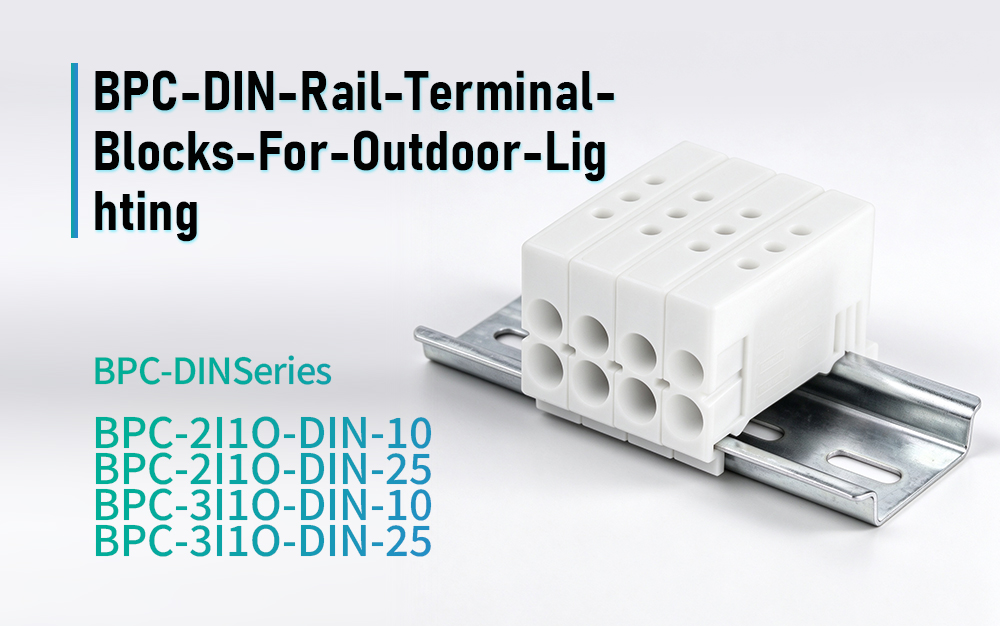
The BPC DIN rail terminal block series includes 2-pole and 3-pole versions for 10 mm² and 25 mm² cables, covering applications from regular street lights to high-power high-mast lights. Each model is built with full-copper conductors and a flame-retardant PA66 housing for long-term outdoor reliability.
4.1 BPC-2I10-DIN-10 — 2-Pole, 10 mm²
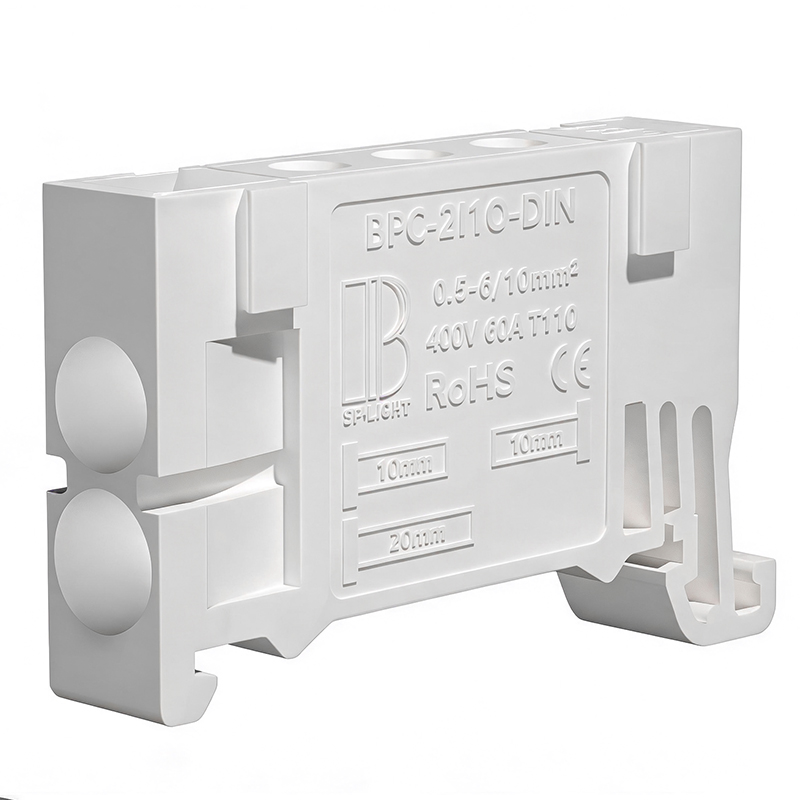
A 2-pole terminal block for 10 mm² cables with an IEC rated current of 57A (UL 80A). Ideal for single-phase power transfer in medium and low power street lights and garden lights.
4.2 BPC-2I10-DIN-25 — 2-Pole, 25 mm²
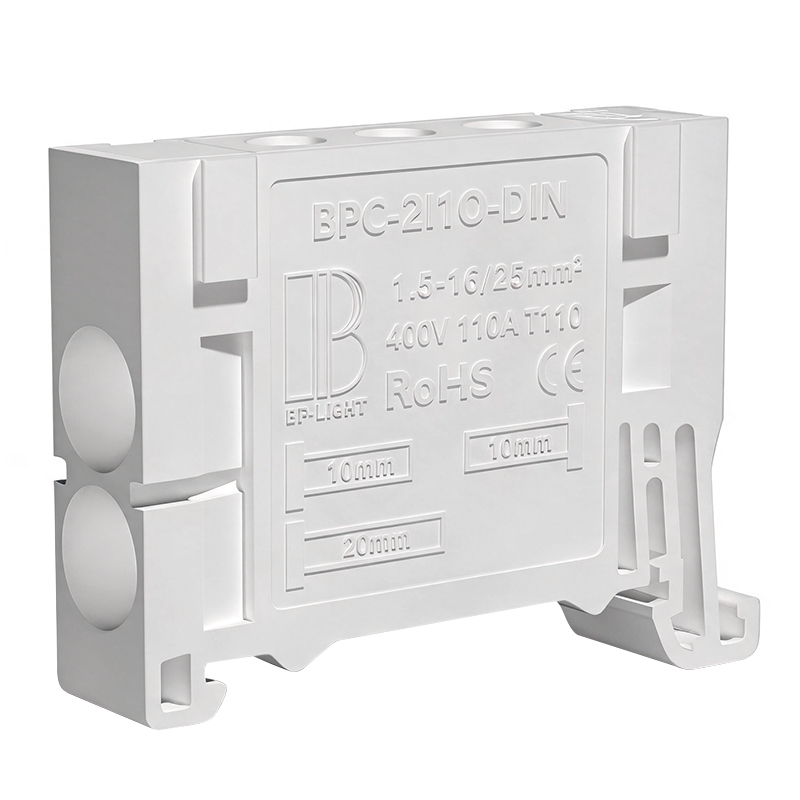
A 2-pole terminal block for 25 mm² cables with an IEC rated current of 101A (UL 150A). Designed for high-power 2-way cable distribution in lighting poles.
4.3 BPC-3I10-DIN-10 — 3-Pole, 10 mm²
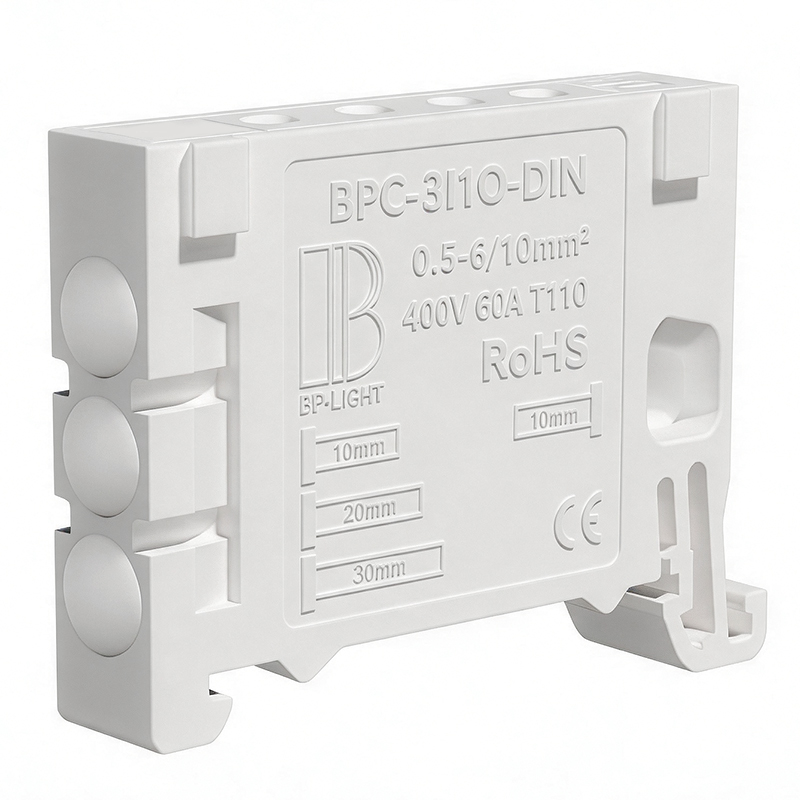
A 3-pole terminal block for 10 mm² cables rated at 57A (IEC) / 80A (UL). The 3-pole design supports L/N/PE connection to meet earthing protection requirements in outdoor lighting.
4.4 BPC-3I10-DIN-25 — 3-Pole, 25 mm²
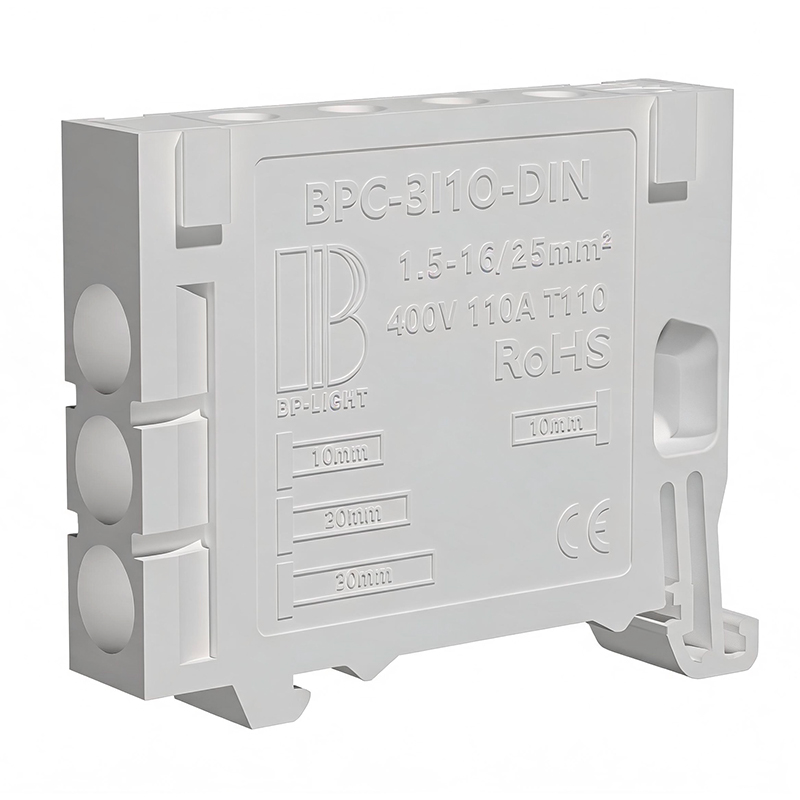
A 3-pole terminal block for 25 mm² cables rated at 101A (IEC) / 150A (UL). Ideal for high-power 3-way distribution in high-mast lights and multi-lamp centralized power supply.
Table 1 BPC Series DIN Rail Terminal Block Selection
| Model | Poles | Conductor Size | Rated Current (IEC) | Rated Current (UL) | Thread / Torque |
| BPC-2I10-DIN-10 | 2 | 10 mm² | 57A | 80A | M4 / 1.5 N·m |
| BPC-2I10-DIN-25 | 2 | 25 mm² | 101A | 150A | M6 / 3.0 N·m |
| BPC-3I10-DIN-10 | 3 | 10 mm² | 57A | 80A | M4 / 1.5 N·m |
| BPC-3I10-DIN-25 | 3 | 25 mm² | 101A | 150A | M6 / 3.0 N·m |
5 Materials & Safety Certifications
The conductive part of the BPC series is made of full copper, offering low resistance, high current-carrying capacity and a low temperature rise under high current. The housing is PA66 with a UL94 V0 flammability rating and an operating temperature range of -40°C to 110°C, withstanding extreme hot and cold outdoor climates while isolating each contact point to prevent short circuits.
The products comply with IEC/EN 60947-7-1 and UL 1059. They have passed mechanical strength, bracket fastening and rotation & pull-out reliability tests, meeting the electrical safety requirements of outdoor lighting projects.
6 How to Choose the Right Terminal Block for Your Lighting Pole
1. Match the conductor size: use 10 mm² models for standard street lights and 25 mm² models for high-power or long-run feeders.
2. Choose the number of poles: 2-pole for single-phase power transfer, 3-pole when line, neutral and earth (L/N/PE) must all be connected.
3. Verify the rated current: the IEC rating must be higher than the maximum load current of the luminaire.
4. Confirm environmental suitability: PA66 housing and a -40°C to 110°C operating range cover most outdoor installations.
7 Frequently Asked Questions
Q1: Why use a terminal block instead of twisting wires in a lighting pole?
A: Twisted and taped joints are prone to oxidation, poor contact and overheating under outdoor conditions. DIN rail terminal blocks provide a standardized, corrosion-resistant and reusable connection that is easy to inspect and maintain.
Q2: What is the difference between 2-pole and 3-pole terminal blocks?
A: A 2-pole block connects two conductors (typically line and neutral). A 3-pole block adds a third pole, enabling line, neutral and earth (L/N/PE) connection for grounding requirements.
Q3: What is the rated current of the BPC series?
A: The 10 mm² models (BPC-2I10-DIN-10, BPC-3I10-DIN-10) are rated at 57A (IEC) / 80A (UL). The 25 mm² models (BPC-2I10-DIN-25, BPC-3I10-DIN-25) are rated at 101A (IEC) / 150A (UL).
Q4: Are BPC terminal blocks suitable for outdoor use?
A: Yes. They use full-copper conductors and a PA66 housing with a UL94 V0 rating and an operating range of -40°C to 110°C, designed for outdoor lighting environments.
Q5: What standards do BPC terminal blocks comply with?
A: They comply with IEC/EN 60947-7-1 and UL 1059, and have passed mechanical strength and reliability tests.
8 Conclusion & Contact
Using DIN rail terminal blocks in lighting poles replaces unstable hand-made joints with standardized, durable components, solving the pain points of oxidation, poor contact and difficult maintenance. The BPC series offers 2/3-pole and 10 mm²/25 mm² options with full-copper conductors and flame-retardant housing, balancing installation efficiency, electrical safety and easy maintenance.
Ready to upgrade your outdoor lighting wiring? Contact our team for BPC series specifications, OEM options and pricing, or request a sample for your next project.