
Table of Contents
2 Drawbacks of Traditional Wiring Methods for Lighting Poles
3 Core Advantages of DIN Rail Terminal Blocks for Outdoor Poles
3.1 Standardized Installation & Stable Connection
3.2 Compatible with Multiple Cable Types
3.3 Easy Maintenance & Reusability
4 BPC Series DIN Rail Terminal Block Selection
5 Material & Safety Certifications 6 Conclusion
1 Introduction
Outdoor street lights, high-mast lights and landscape garden lights are exposed to harsh natural conditions. The interior of the pole is the core area for power transfer and cable branching. Rain, salt spray and extreme temperature fluctuations continuously challenge the reliability of cable joints. Failed joints may lead to lamp outage, overheating and even electrical hazards.
The quality of traditional field twisted or welded cable joints is unstable. DIN rail mounted terminal blocks adopt a standardized mechanical clamping connection, which has become the preferred wiring solution for outdoor lighting pole projects.
2 Drawbacks of Traditional Wiring Methods for Lighting Poles
Space inside lighting poles is limited and on-site conditions are constrained. If cables are twisted and wrapped with insulating tape, the tape will crack under long-term UV exposure. Moisture enters the joint, copper conductors oxidize, contact resistance rises and the joint overheats, resulting in poor contact and power failure.
Welding provides good conductivity, but cables must be cut during maintenance or renovation, which means cables cannot be reused and maintenance cost is high. Welding quality heavily relies on workers’ skill, making it hard to control consistency across projects.
3 Core Advantages of DIN Rail Terminal Blocks for Outdoor Poles
3.1 Standardized Installation & Stable Connection
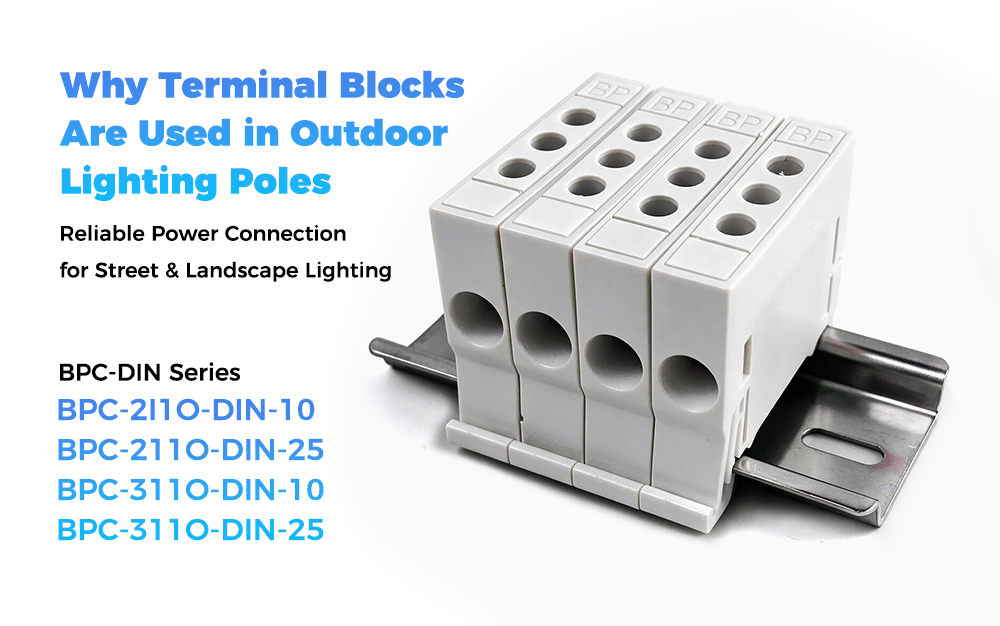
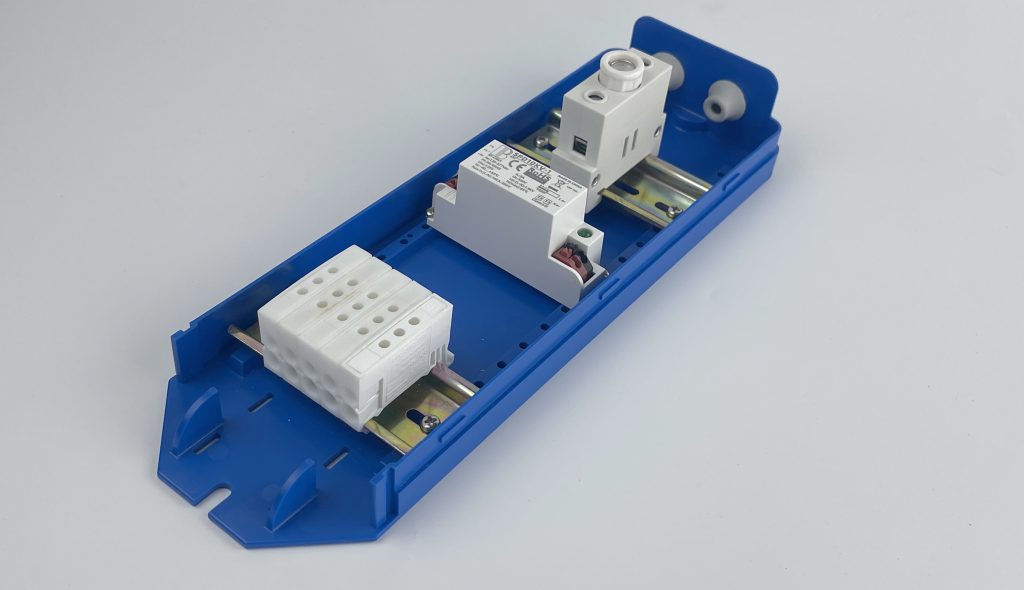
The screw-clamping structure secures cables with a defined torque, eliminating human error and poor contact. Designed for DIN-35 rail snap mounting, the terminal blocks clip onto the rail inside the pole, keeping wiring neat and easy for project inspection.
3.2 Compatible with Multiple Cable Types
Compatible with solid conductors, stranded conductors and fine-stranded conductors with insulated ferrules. Stripping length only needs 10–30mm. Front wiring design simplifies on-site wiring.
3.3 Easy Maintenance & Reusability
No cable cutting is required for lamp replacement or circuit modification. Cables can be detached by loosening the screws. Both terminals and cables are reusable, greatly cutting maintenance labor cost.
4 BPC Series DIN Rail Terminal Block Selection
The BPC DIN rail terminal block series includes 2-pole and 3-pole versions for 10mm² and 25mm² cables, covering applications from regular street lights to high-power high-mast lights. The selection parameters are shown in Table 1.
Table 1 BPC Series DIN Rail Terminal Block Selection
| Model | Poles | Conductor Size | Rated Current (IEC) | Thread / Torque |
| BPC-2I10-DIN-10 | 2 | 10mm² | 57A | M4 / 1.5N·m |
| BPC-2I10-DIN-25 | 2 | 25mm² | 101A | M6 / 3.0N·m |
| BPC-3I10-DIN-10 | 3 | 10mm² | 57A | M4 / 1.5N·m |
| BPC-3I10-DIN-25 | 3 | 25mm² | 101A | M6 / 3.0N·m |
BPC-2I10-DIN-10 is a 2-pole unit for 10mm² cable with a rated current of 57A, suitable for single-phase power transfer of medium and low power lamps. BPC-2I10-DIN-25 is a 2-pole unit for 25mm² cable rated at 101A for high-power 2-way distribution. BPC-3I10-DIN-10 is a 3-pole unit that supports L/N/PE connection to meet earthing protection requirements. BPC-3I10-DIN-25 is a 3-pole unit for 25mm² cable, widely used for high-power 3-way distribution in high-mast lights and multi-lamp centralized power supply.
5 Material & Safety Certifications
The conductive part is made of full copper, featuring low resistance and high current-carrying capacity. It runs stably with a low temperature rise under high current. The housing material is PA66 with flame retardant class UL94-V0. The operating temperature range is -40℃~110℃, withstanding extreme hot and cold outdoor climates. The insulated housing isolates each contact point to avoid short circuit.
The products comply with IEC/EN 60947-7-1 and UL1059. They have passed mechanical strength, bracket fastening, rotation & pull-out reliability tests and meet the electrical safety requirements of outdoor lighting projects.
6 Conclusion
Using DIN rail terminal blocks in lighting poles replaces unstable hand-made joints with standardized components, solving the pain points of oxidation, poor contact and difficult maintenance. The four models of the BPC series offer 2/3-pole and 10mm²/25mm² options. With full copper conductors and flame-retardant high-temperature housing, they balance installation efficiency, electrical safety and easy maintenance, serving as a reliable wiring solution for outdoor lighting pole projects.