
Table of Contents
- 1. Introduction: The Hidden Risk of Outdoor LED Lighting
- 2. Why Outdoor LED Lights Must Equip SPD?
- 3. Main Sources of Surge Damage for Outdoor LED Luminaires
- 4. Global & European SPD Standards for Outdoor LED Lighting
- 5. SPD Classification & Suitable Application Scenarios
- 6. Core SPD Parameters for Outdoor LED Projects (10kV/20kV, Uc, Common/Differential Mode)
- 7. Mandatory Certifications for EU & Global Projects
- 8. Real Project Case: How SPD Solves Outdoor LED Mass Failure
- 9. Frequently Asked Questions
- 10. Final Conclusion
1. Introduction: The Hidden Risk of Outdoor LED Lighting
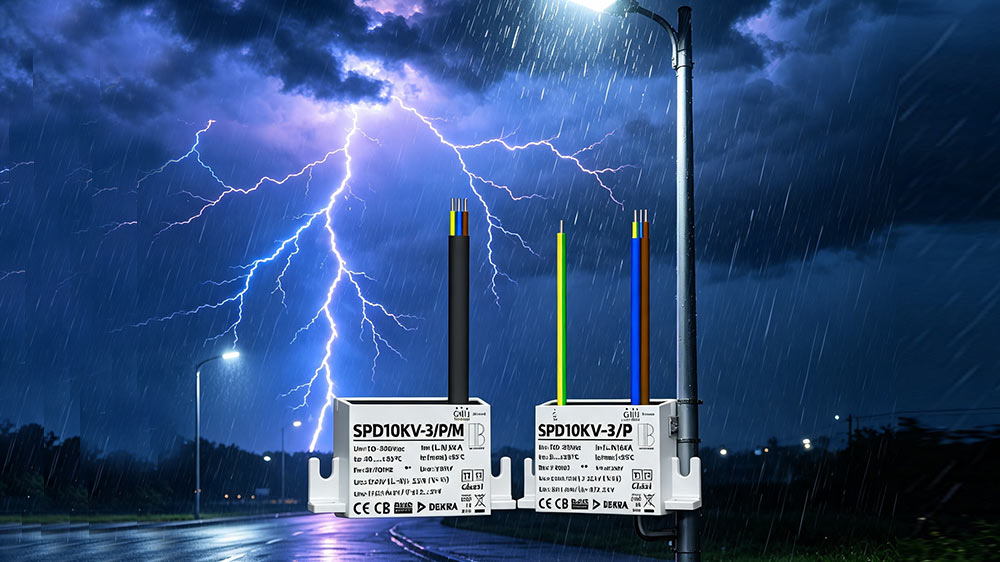
Outdoor LED lighting solutions, including LED street lights, floodlights, high bay lights, and landscape lighting, have become the dominant option for municipal, commercial, and industrial projects worldwide, thanks to their outstanding energy efficiency, low power consumption, and ultra-long service life. However, unlike traditional halogen and sodium lamps with strong tolerance to electrical fluctuations, modern outdoor LED lighting systems depend on precise, sensitive LED drivers. These delicate electronic components cannot withstand sudden transient high-voltage surges caused by lightning induction or unstable power grid fluctuations, making professional LED surge protection devices (SPD) indispensable.
The vast majority of outdoor LED lamp failures during thunderstorm seasons are not caused by poor lamp quality, but by the lack of reliable LED SPD surge protection. A high-quality Type 3 outdoor LED SPD acts as the primary safety barrier for all outdoor LED luminaires, effectively preventing driver burnout and lamp damage, cutting down frequent maintenance costs, and guaranteeing long-term stable operation of outdoor LED lighting systems in harsh outdoor environments.
2. Why Outdoor LED Lights Must Equip SPD?
A common misconception among global buyers and engineering contractors is that IP65 or IP67 waterproof ratings can protect outdoor LED lights from lightning and electrical surges. This is incorrect. IP waterproof grades only defend against water and dust ingress, while only professional LED SPD surge protection devices can resist high-voltage lightning surges and grid transient spikes. Waterproofing protects the lamp housing, and LED surge protection safeguards the core electronic driver circuits.
The core reasons for mandatory SPD installation for outdoor LED lights are as follows:
- Sensitive LED Driver Electronic Structure: Modern LED drivers adopt high-precision semiconductor circuits with low surge tolerance. Unprotected 10kV–20kV transient lightning surges common in outdoor power grids will burn out driver chips and circuits instantly, leading to lamp failure.
- Harsh Exposed Outdoor Installation: Outdoor LED street lights and floodlights are mostly installed in open roads, coastal areas, mountainous regions, and industrial zones with long overhead power cables. These exposed cables easily induce lightning surges, posing constant threats to unprotected LED lighting systems.
- High Maintenance Cost: Mass LED burnout after thunderstorms leads to expensive replacement labor and material costs, and even causes public lighting safety hazards.
- Strict Global Standard Compliance: European municipal projects, commercial outdoor lighting tenders, and international industrial lighting projects all explicitly mandate built-in Type 3 LED SPD. Installing certified Type 3 LED surge protection devices is now a basic requirement for EU project inspection, technical acceptance, and legal market compliance.
3. Main Sources of Surge Damage for Outdoor LED Luminaires
Outdoor LED surge damage mainly comes from two categories of transient voltage spikes, far beyond the withstand range of standard 230V LED drivers:
- Indirect Lightning Induction (90% of outdoor LED failures): Direct lightning strikes on lamps are rare, but indirect lightning electromagnetic induction generates ultra-high transient voltage on long outdoor overhead cables. This is the leading cause of LED driver breakdown and mass outdoor LED lamp damage in systems without reliable LED SPD surge protection.
- Grid Switching Surges: Transient voltage fluctuations caused by transformer switching, large equipment startup, and grid load adjustment.
- Regional Grid Instability: Voltage drift and surge interference in remote mountainous areas, coastal thunderstorm zones, and rural power grids.
4. Global & European SPD Standards for Outdoor LED Lighting
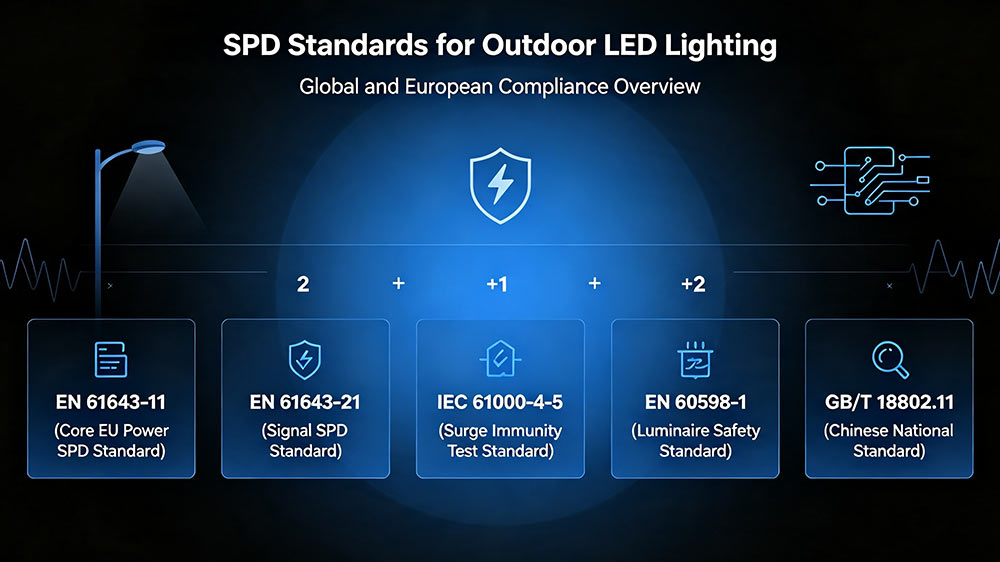
Different regions and projects follow unified international and EU standards to standardize SPD selection and installation. These standards are the core basis for product compliance and project certification:
4.1 EN 61643-11 (Core EU Power SPD Standard)
EN 61643-11 is the core mandatory EU standard for low-voltage AC surge protective devices, specifically formulated for built-in LED SPD and LED driver surge protection. It unifies SPD test types, surge protection performance parameters, and electrical safety specifications, serving as the primary technical and compliance standard for all outdoor LED lighting products and built-in LED SPD modules entering the European market.
4.2 EN 61643-21 (Signal SPD Standard)
Special standard for smart lighting signal lines (DALI, 0-10V, 1-10V dimming). It regulates low-capacitance and low-interference protection requirements to avoid dimming flicker or communication failure.
4.3 IEC 61000-4-5 (Surge Immunity Test Standard)
IEC 61000-4-5 is the global unified surge immunity test standard for electrical and electronic equipment, including all outdoor LED luminaires and drivers. It defines standard 1.2/50μs and 8/20μs combination wave test waveforms, and all mainstream 10kV and 20kV LED SPD surge level parameters are strictly tested and verified based on this standard.
4.4 EN 60598-1 (Luminaire Safety Standard)
It clearly stipulates that all outdoor lighting fixtures must be equipped with qualified surge protection devices to ensure electrical safety and system stability.
4.5 GB/T 18802.11 (Chinese National Standard)
Equivalent to IEC 61643-11, applicable to domestic engineering and export supporting certifications.
5. SPD Classification & Suitable Application Scenarios
According to EN 61643-11, SPDs are divided into three types, with clear matching rules for outdoor LED lighting projects:
- Type 1 SPD: For direct lightning protection, installed in the main distribution cabinet of buildings.Not used for built-in LED lamps, with ultra-large current discharge capacity.
- Type 2 SPD: For induced lightning protection, installed in regional distribution boxes. Suitable for overall surge protection of large-scale outdoor lighting systems.
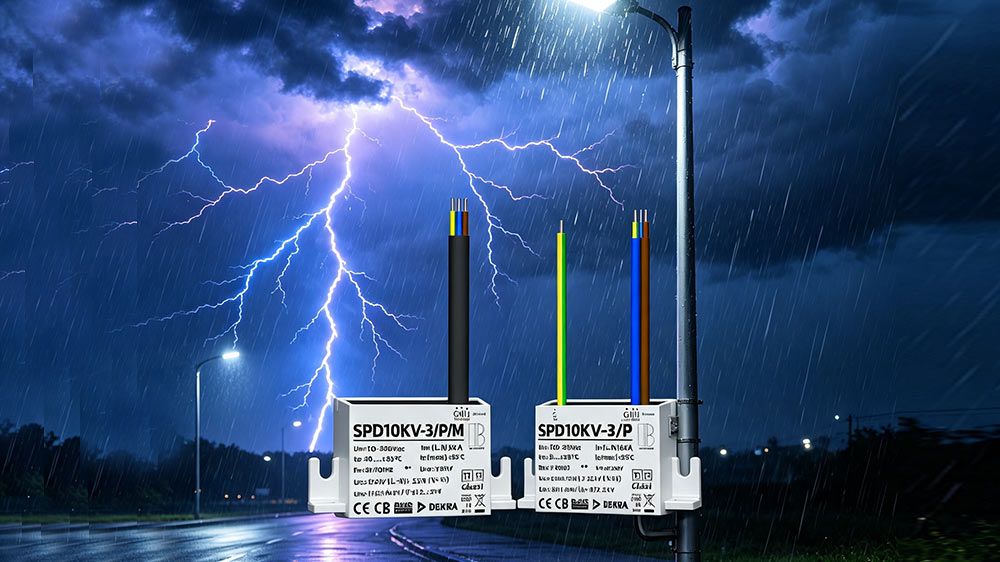
- Type 3 SPD: Features precision equipment-level surge protection,the most suitable and mainstream SPD type for built-in outdoor LED street lights and floodlights. With compact size, low power consumption, and precise voltage clamping performance, it perfectly matches the protection needs of low-power and medium-power LED drivers, making it the standard SPD configuration for global municipal and commercial outdoor LED lighting projects.
Best Cascaded LED Surge Protection Solution: Industry-standard dual protection system — Type 2 SPD installed in distribution boxes for overall grid surge filtering + built-in Type 3 LED SPD for single luminaire precision protection. This layered surge protection strategy fully eliminates outdoor lightning and grid surge risks, significantly lowering outdoor LED lamp and driver failure rates.
6. Core SPD Parameters for Outdoor LED Projects
Reasonable parameter selection is the key to effective protection, matching different regional environmental requirements:
6.1 10kV vs 20kV Surge Level
- 10kV LED SPD: The standard and cost-effective surge protection solution for urban roads, residential community lighting, and areas with stable power grids and low lightning risk. It is widely approved and specified in standard European municipal outdoor LED street light and floodlight projects.
- 20kV LED SPD: Enhanced high-grade surge protection configuration, specially designed for high-risk lightning areas including coastal zones, mountain highways, open rural areas, and outdoor lighting projects with long overhead cables.
6.2 Uc (Maximum Continuous Operating Voltage)
- Uc 275V LED SPD: Matches standard 230V EU mains and stable TN grid systems in urban areas, the most common Uc parameter for conventional outdoor LED street light SPD.
- Uc 320V LED SPD: Adaptable to unstable power grids, TT earthing systems, and remote areas with frequent voltage drift. It effectively avoids premature aging, leakage, and burnout of LED SPD caused by long-term grid voltage fluctuation.
6.3 Common Mode + Differential Mode Full Protection
Professional-grade outdoor LED SPD must support complete dual surge protection modes: Differential mode protection (L-N) to suppress daily grid switching surges and voltage fluctuations, and common mode protection (L-PE/N-PE) to resist lightning-induced high-voltage surges. Single differential mode protection is incomplete and cannot cope with mainstream outdoor lightning risks, failing to fully protect LED drivers.
6.4 Built-in Thermal Disconnector
A built-in thermal disconnector is a must-have safety feature for qualified outdoor LED SPD. When the internal varistor ages or overheats due to continuous surge impact, the thermal disconnector will automatically disconnect the failed SPD from the circuit. This prevents circuit shorting and potential fire hazards, ensuring the outdoor LED luminaire maintains normal operation without power interruption after SPD failure.
7. Mandatory Certifications for EU & Global Projects
To meet international project bidding and customs requirements, outdoor LED matching SPDs must have authoritative certifications:
- CE Certification (Mandatory for EU): Complies with LVD 2014/35/EU and EMC 2014/30/EU directives, basic market access qualification.
- TÜV Certification: Widely recognized in Europe, high credibility for municipal and large engineering projects.
- VDE Certification: Preferred standard for German and high-end European projects.
- CB Certification: Global mutual recognition, convertible to various national local certifications.
8. Real Project Case: How SPD Solves Outdoor LED Mass Failure
Project Background: A Southern European municipal street lighting project with 1500 outdoor LED street lights, covering urban and suburban overhead cable sections.
Initial Problem: The project initially adopted low-cost uncertified LED SPD with only single differential mode protection and no thermal disconnector. After two thunderstorms, over 80 LED drivers were burned out, causing large-scale street light outage, severe lighting system failure, and huge after-sales maintenance pressure.
Optimized Solution:
- Urban stable grid sections: Equipped with Type 3 10kV SPD (Uc275V, common + differential mode, with thermal disconnector).
- Suburban high lightning-risk sections: Upgraded to Type 3 20kV SPD (Uc320V).
- Added Type 2 SPD in the project distribution cabinet to form cascaded protection.
- Standardized grounding construction for all lamp poles.
Project Result: After upgrading to standardized Type 3 LED SPD with complete protection functions, the outdoor LED driver and lamp failure rate dropped by 92% during thunderstorm seasons, proving the reliability of standardized Type 3 LED SPD protection. Zero fire safety risks occurred, and the entire municipal outdoor lighting project successfully passed EU standard official acceptance with stable long-term operation.
9. Frequently Asked Questions
Q1: Can outdoor LED lights work without SPD?
Indoor low-risk fixed lighting can omit SPD devices, but all outdoor LED luminaires, including street lights, floodlights, and landscape lighting, must be equipped with professional Type 3 LED SPD surge protection. The open and exposed outdoor environment brings uncontrollable lightning surge risks, and unprotected LED drivers are extremely susceptible to burnout and permanent damage.
Q2: Is 10kV or 20kV SPD better for street lights?
For most urban outdoor LED street light projects with stable grids and low lightning density, 10kV LED SPD is the standard cost-effective choice. For coastal, mountainous, and rural high lightning-risk areas, 20kV enhanced LED SPD is recommended. Always prioritize project tender specifications and local environmental conditions for SPD selection.
Q3: Does SPD need grounding to work?
Absolutely yes. Grounding is a prerequisite for LED SPD normal operation. The core working principle of LED surge protection devices is to discharge transient surge current to the ground via the PE wire. Poor grounding, loose wiring or no grounding will completely invalidate the LED SPD protection function, leaving outdoor LED lights unprotected against lightning surges.
Q4: Can power SPD replace signal SPD for dimming lines?
No. Ordinary power LED SPD has high internal capacitance, which will cause severe DALI/0-10V dimming flicker, signal distortion and communication failure. Smart outdoor LED lighting systems with dimming functions must adopt dedicated signal SPD compliant with EN 61643-21 standards to ensure stable signal transmission and effective surge protection.
10. Final Conclusion
LED SPD is no longer an optional accessory but an indispensable core safety component for all qualified outdoor LED lighting systems. Facing complex outdoor lightning environments and strict EU EN 61643 series standards, standardized Type 3 LED SPD with dual common/differential mode protection, reasonable Uc & surge level parameters, built-in thermal disconnector, and authoritative certifications can effectively avoid outdoor LED lamp burnout, reduce project maintenance costs, and greatly improve the overall reliability and service life of outdoor LED lighting equipment.
For global municipal, commercial, and industrial outdoor LED lighting projects, scientific matching of Type 3 LED SPD with 10kV/20kV surge grades and corresponding parameters according to regional lightning risks and grid conditions is the key to project compliance, stable operation, and long-term cost savings.