
Table of Contents
- 1. Introduction: Why LED Lighting Needs SPD
- 2. What Causes Voltage Surges on LED Luminaires?
- 3. How Does an LED Surge Protection Device (SPD) Work?
- 4. Common-Mode vs Differential-Mode Surge Protection
- 5. SPD Classification: Type 1 / Type 2 / Type 3 for LED Lights
- 6. Key Technical Parameters: Uc, Up, 10kV & 20kV Surge Level
- 7. Global Standards for LED SPD (Mainly European Market)
- 8. Wiring Rules: Parallel Power SPD & Series Signal SPD
- 9. Practical Engineering Case Study
- 10. Common Mistakes in SPD Selection & Installation
- 11. SPD vs Overvoltage / Undervoltage Protection
- 12. Frequently Asked Questions
- 13. Conclusion
1. Introduction: Why LED Lighting Needs SPD
Modern LED luminaires rely on sensitive electronic LED drivers, which are far more vulnerable to electrical disturbances than traditional halogen or sodium lamps. Solid-state driver circuits cannot withstand short-duration, high-voltage transient surges generated by lightning or grid fluctuations.
Outdoor LED lighting, including street lights, flood lights, high bay lights, and parking lot lighting, is installed in fully exposed environments with long overhead cables. These installation conditions create continuous surge risks. Without professional surge protection devices (SPD), LED drivers burn out frequently during thunderstorms, resulting in high maintenance costs, public lighting safety risks, and negative project complaints.
Today, an LED SPD is no longer an optional accessory. It has become a standard and mandatory safety component for most European municipal and commercial outdoor lighting projects, ensuring long-term luminaire stability and project compliance.
2. What Causes Voltage Surges on LED Luminaires?
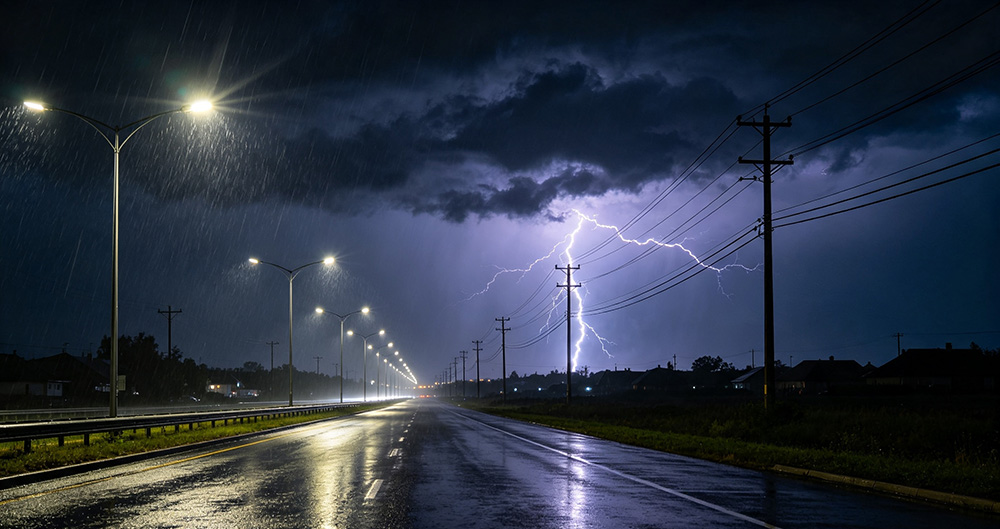
Most people misunderstand LED lamp burnout as quality issues. In fact, over 90% of outdoor LED failures are caused by transient voltage surges that exceed the driver’s withstand capacity. The main surge sources are listed below:
- Indirect lightning strikes: The most common cause for street light damage. Nearby lightning generates strong electromagnetic induction on overhead cables, producing ultra-high transient voltage.
- Grid switching fluctuations: Transient spikes caused by transformer operation, large equipment startup, and frequent power grid load switching.
- Cable induction & static discharge: Long outdoor exposed cables easily accumulate static electricity and induce surge interference.
- Unstable regional power grids: Remote mountainous areas, coastal thunderstorm zones, and rural regions suffer from irregular voltage drift and surge noise.
These surges only last for microseconds but can reach 10kV to 20kV, far exceeding the safe operating voltage of standard 230V LED drivers.
3. How Does an LED Surge Protection Device (SPD) Work?
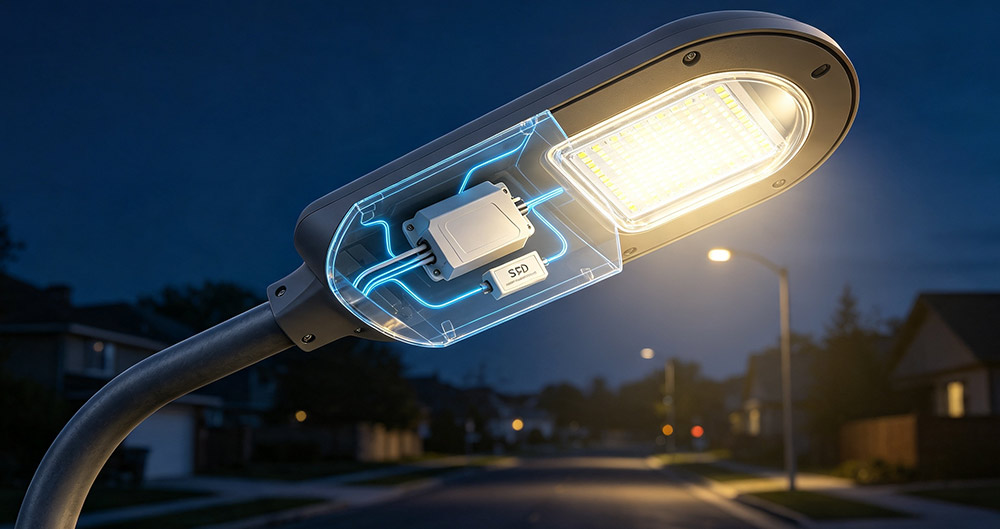
Nearly all standard LED power SPDs adopt parallel installation with the LED driver’s input circuit. The working mechanism is automatic, fast, and non-intrusive to normal lighting operation.
3.1 Normal Working State
Under stable grid voltage, the LED SPD maintains a high-impedance state. No current passes through the SPD module, and the luminaire works normally without any interference or power loss.
3.2 Surge Trigger State
Once a dangerous high-voltage surge spike invades the circuit, the SPD instantly switches to a low-impedance conduction state within microseconds.
3.3 Voltage Clamping & Surge Discharging
The SPD clamps the overvoltage to a safe level and diverts the huge surge current to the earth via the PE grounding wire, completely isolating high voltage from the LED driver.
3.4 Automatic Recovery
After the surge disappears, the SPD automatically returns to high-impedance standby mode and continues real-time protection.
Core Working Principle: LED SPD does not store electricity. It acts as a fast switch to redirect transient surge energy to ground before it damages sensitive LED driver components.
4. Common-Mode vs Differential-Mode Surge Protection
To achieve full lightning protection, LED SPD must support dual-mode protection (both common mode and differential mode). Single-mode protection cannot avoid lamp burnout.
- Differential Mode Surge (L-N): Voltage spikes between live wire and neutral wire, mainly caused by daily grid fluctuations and equipment switching. It affects circuit voltage balance.
- Common-Mode Surge (L-PE / N-PE): Voltage spikes between power lines and ground. This is the main cause of outdoor LED lightning damage, induced by outdoor thunderstorm electromagnetic fields.
Professional Recommendation: Always select LED SPD with both common-mode and differential-mode protection. SPD with only differential protection will still fail during real lightning strikes.
5. SPD Classification: Type 1 / Type 2 / Type 3 for LED Lights
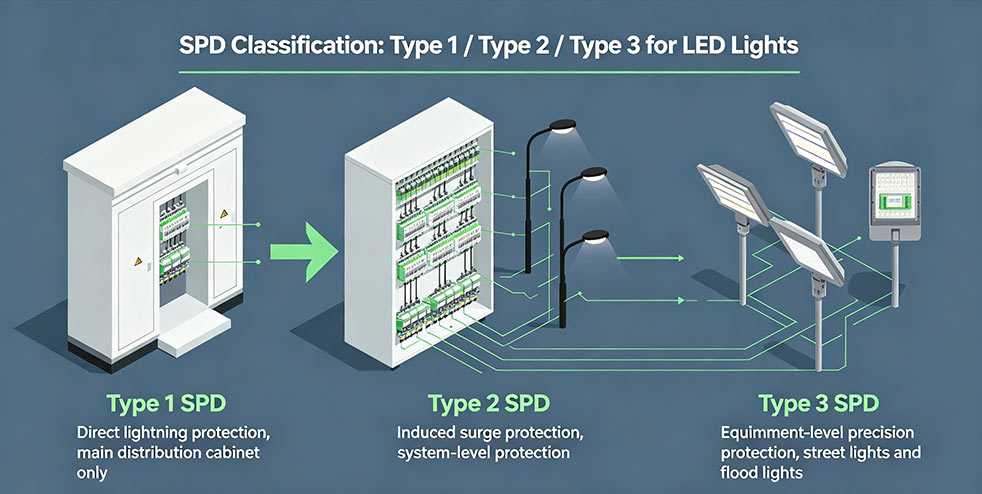
According to the international standard EN 61643-11, SPDs are divided into three types with clear application scenarios for outdoor LED lighting:
- Type 1 SPD: Designed for direct lightning strike protection with ultra-large current discharge capacity. Installed only in building main distribution cabinets. Not applicable for built-in LED luminaires.
- Type 2 SPD: Used for induced lightning surge protection, installed in power distribution panels. Suitable for system-level overall protection of large-scale outdoor lighting projects.
- Type 3 SPD: Equipment-level precision protection.This is the most widely used SPD for built-in street lights and flood lights, featuring small size, low residual voltage, and perfect matching with LED driver parameters.
Best Cascaded Protection Solution: Type 2 SPD (distribution cabinet overall protection) + Built-in Type 3 SPD (single luminaire precise protection), which is the standard solution for European municipal street lighting.
6. Key Technical Parameters: Uc, Up, 10kV & 20kV Surge Level
Correct parameter selection determines the actual protection effect and service life of LED SPD.
6.1 Uc (Maximum Continuous Operating Voltage)
Uc refers to the maximum stable AC voltage that the SPD can withstand long-term without aging or leakage.
- Uc 275V: Suitable for standard stable 230V urban grid systems (TN system).
- Uc 320V: Suitable for unstable grids, TT earthing systems, and remote areas with frequent voltage deviation.
6.2 Up (Voltage Protection Level)
Up represents the residual voltage after SPD suppresses the surge. The lower the Up value, the better the protection performance, providing safer voltage clamping for LED drivers.
6.3 10kV / 20kV Surge Level (IEC 61000-4-5 Combination Wave)
- 10kV SPD: Standard configuration for urban areas, low lightning-risk regions, and buried cable lighting projects.
- 20kV SPD: Enhanced configuration for coastal areas, mountain highways, open rural zones, and long overhead cable projects with high thunderstorm frequency.
7. Global Standards for LED SPD (Mainly European Market)
All exported outdoor LED SPD must comply with unified international and EU standards to pass project inspection and market access.
7.1 Core Industry Standards
- EN 61643-11: Mandatory standard for AC power SPD, the core certification basis for built-in luminaire surge protectors.
- EN 61643-21: Special standard for signal SPD, applicable to DALI and 0–10V dimming line protection.
- IEC 61000-4-5: Global unified surge immunity test standard for LED drivers and luminaires.
- EN 60598-1: Luminaire safety standard, clearly defining surge protection requirements for outdoor lighting.
7.2 Main EU Market Certifications
- CE Mark: Mandatory for EU market entry (complies with LVD & EMC directives).
- TÜV Certificate: Highly recognized for European municipal projects.
- VDE Certificate: Preferred high-end certification for German and premium lighting projects.
- CB Certificate: Global mutual recognition certification for multi-country project adaptation.
8. Wiring Rules: Parallel Power SPD & Series Signal SPD
Wrong wiring is one of the top reasons for SPD failure. Power SPD and signal SPD have completely different wiring methods and cannot be mixed.
8.1 AC Power SPD (L-N-PE) — Parallel Wiring
Connect SPD L to mains live wire, SPD N to mains neutral wire, and SPD PE to grounding wire. The power SPD is parallel to the main circuit. Even if the SPD ages and fails, the luminaire can still work normally without power interruption.
8.2 Signal SPD (DALI / 0–10V) — Series Wiring
Wire sequence: Controller signal output → SPD INPUT → SPD OUTPUT → LED driver signal terminal.
Critical Reminder: Never use ordinary power SPD for signal lines. High capacitance of power SPD will cause dimming flicker, signal distortion, and communication failure.
Key Premise: All SPDs require reliable PE grounding. Poor or missing grounding will completely invalidate surge protection.
9. Practical Engineering Case Study
Project Background
A Southern European municipal street lighting renovation project with 1,200 LED street lights (230V AC). The project covers urban buried cable sections (low lightning risk) and suburban overhead cable sections (frequent thunderstorms).
Initial Problem
The initial scheme adopted unified 10kV SPD without differentiated configuration and standardized grounding. After two thunderstorms, nearly 70 LED drivers were damaged in suburban overhead line sections, causing large-scale lamp failure.
Optimized SPD Solution
- Urban areas: Adopt Type 3 10kV SPD (Uc=275V, common + differential dual mode).
- Suburban high-risk areas: Upgrade to Type 3 20kV SPD (Uc=320V).
- Add Type 2 SPD in central distribution cabinets for cascaded protection.
- Standardize professional grounding for all lamp poles.
- Uniformly select SPD with built-in thermal disconnector for fire safety protection.
Project Result
After optimization, the LED driver failure rate dropped by over 90% during thunderstorm seasons. The project eliminated mass maintenance issues and successfully passed EU municipal acceptance.
10. Common Mistakes in SPD Selection & Installation
Most SPD protection failures are caused by human error rather than product quality problems:
- Ignoring grounding standards, using thin or loose PE wires.
- Choosing single differential-mode SPD without common-mode lightning protection.
- Incorrect Uc parameter selection, causing long-term SPD overheating and burnout.
- Installing SPD too far from the LED driver, resulting in excessive residual voltage.
- Using power SPD for dimming signal lines, causing signal failure and flicker.
- Selecting low-cost SPD without thermal disconnector, bringing fire hazards after aging.
- One SPD drives dozens of luminaires, leading to insufficient protection for remote lamps.
- Confusing surge voltage (kV) with discharge current (kA), resulting in mismatched models.
11. SPD vs Overvoltage / Undervoltage Protection
Many buyers confuse SPD with OVP/UVP, but their protection principles and scenarios are completely different and cannot replace each other.
- SPD (Surge Protection Device): Protects against microsecond-level transient lightning spikes. It solves instantaneous high-voltage surge impact.
- OVP / UVP (Overvoltage / Undervoltage Protection): Protects against long-term steady abnormal voltage (caused by broken neutral wires or grid failure).
Complete High-Reliability Solution: SPD + OVP/UVP combined protection, covering both transient surge risks and steady grid voltage abnormalities.
12. Frequently Asked Questions
Q1: Does every LED SPD need a thermal disconnector?
Standards do not force all SPDs to carry thermal disconnectors. However, built-in Type 3 SPD for outdoor street lights must be equipped with thermal disconnectors. It automatically disconnects the aging and short-circuited SPD to avoid thermal runaway, smoke, and fire risks, ensuring lamp normal operation.
Q2: Is signal SPD necessary for DALI smart street lights?
It is highly recommended for outdoor long-distance signal cables. If signal wires are short and fully buried in metal conduits, signal SPD can be omitted according to project requirements.
Q3: Can LED SPD work without a ground wire?
No. Grounding is the only channel for surge discharge. Without reliable PE grounding, the SPD cannot release surge current, and the protection function fails completely.
Q4: Can I use 20kV SPD to replace 10kV SPD for all projects?
Technically feasible but cost-ineffective. 20kV SPD has higher material costs. Urban low-risk areas prioritize 10kV SPD for cost performance, while high-risk areas must adopt 20kV enhanced protection. Always follow project tender specifications.
13. Conclusion
LED Surge Protection Devices (SPD) are the core guarantee for the stable operation of outdoor LED lighting systems. Different from simple IP waterproof protection, professional Type 3 SPD effectively solves lightning induction and grid surge problems that cause LED driver burnout.
Compliant SPD selection must follow EN 61643-11 standards, match 10kV/20kV surge levels and Uc parameters according to regional environments, and adopt dual common/differential mode protection with thermal disconnector. Standardized wiring and reliable grounding are essential to maximize protection performance.
For European municipal and global outdoor LED projects, scientific SPD configuration greatly reduces maintenance costs, improves project compliance, and extends the service life of street lights and floodlights.
If you need customized SPD solutions for your LED luminaires, contact our engineering team for professional technical support and project matching services.