
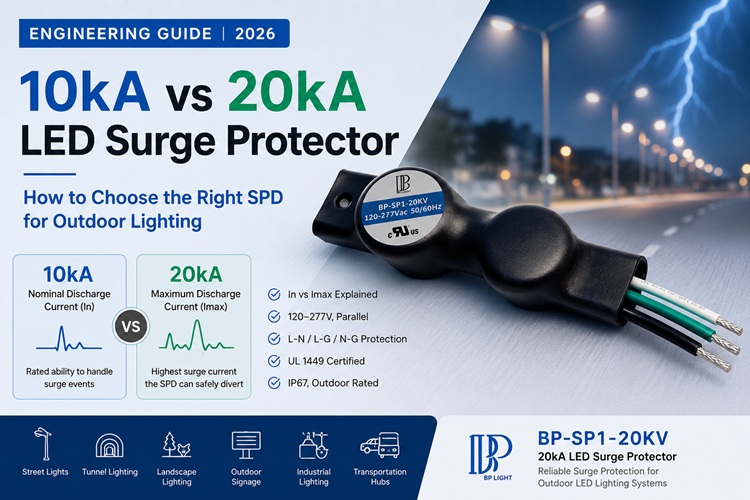
10kA vs 20kA LED Surge Protector: Start by Understanding In and Imax
When selecting surge protection for outdoor LED lighting, engineers and project buyers often encounter ratings such as 10kA and 20kA. A larger number may appear to indicate a stronger surge protector, but these values cannot be compared correctly until you know which electrical parameter each number represents.</p
For the BP-SP1-20KV LED Surge Protection Device, the two ratings describe different parameters of the same SPD: 10kA is the nominal discharge current (In), while 20kA is the maximum discharge current (Imax). They are not two separate BP-SP1-20KV models and should not be treated as directly competing ratings.
Understanding this distinction is important when specifying surge protection for street lighting, tunnel lighting, landscape lighting, outdoor signage, and other outdoor LED systems.
What Does 10kA Nominal Discharge Current (In) Mean?
Nominal discharge current (In) is a standardized surge-current rating used to characterize SPD performance under defined test conditions. It is one of the key parameters engineers may encounter when evaluating the surge-handling capability of an SPD.
For the BP-SP1-20KV, the specified nominal discharge current is:
In = 10kA
This value should always be read together with the applicable test conditions and other SPD specifications. It should not be interpreted simply as the largest surge the device can handle, nor should it be compared with another product’s current rating unless both values represent the same parameter.
What Does 20kA Maximum Discharge Current (Imax) Mean?
Maximum discharge current (Imax) is a different surge-current parameter that represents a higher discharge-current capability defined under the applicable test method.
For the BP-SP1-20KV, the specified maximum discharge current is:
Imax = 20kA
The important point is that Imax and In describe different aspects of SPD performance. A specification showing 20kA Imax should therefore not automatically be compared with another specification showing 10kA In as though both numbers represent the same test or performance criterion.
10kA In vs 20kA Imax: Why They Are Not Competing Ratings
The BP-SP1-20KV provides a useful example of why the phrase 10kA vs 20kA surge protector can be misleading without additional context. This product carries both ratings:
- Nominal Discharge Current (In): 10kA
- Maximum Discharge Current (Imax): 20kA
These values belong to the same surge protection device. The correct engineering question is therefore not simply, “Should I choose 10kA or 20kA?” Instead, buyers should ask:
- Does the stated kA value refer to In, Imax, or another surge-current parameter?
- Are the products being compared using the same type of rating?
- What test conditions apply to the published values?
- Does the SPD match the electrical and environmental requirements of the lighting system?
This distinction is particularly important when comparing datasheets from different SPD suppliers. Two products may display different headline kA values while actually referring to different electrical parameters.
Why a Higher kA Number Does Not Automatically Mean a Better LED SPD
Surge-current capability is important, but selecting an LED surge protector only by choosing the largest kA number can lead to an incomplete specification.
An outdoor lighting SPD must work as part of the complete electrical system. Engineers should consider system voltage, surge-current ratings, protection modes, connection method, environmental protection, applicable standards or certifications, grounding, and compatibility with the LED driver and luminaire design.
For example, a higher Imax value does not by itself confirm that an SPD is appropriate for a particular street lighting project. The system voltage and protection configuration still need to match the installation requirements.
How to Choose an SPD for Outdoor LED Lighting
1. Confirm the Lighting System Voltage
Start with the electrical characteristics of the lighting system. The SPD voltage specification must be compatible with the LED driver and power system in which it will be installed.
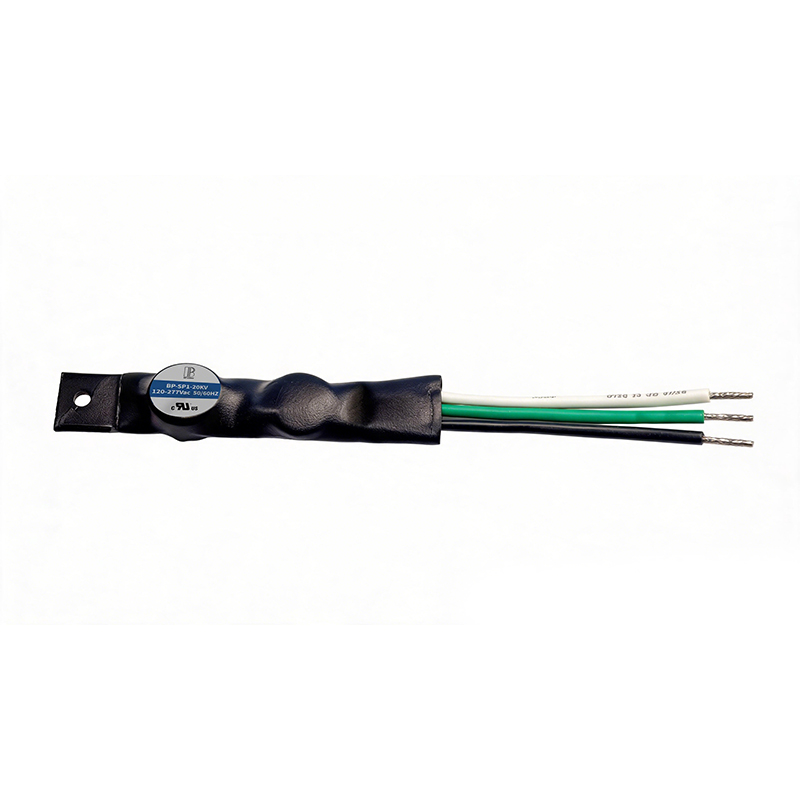
The BP-SP1-20KV supports an input voltage range of 120–277V. Its specified maximum continuous operating voltage is AC 320V / DC 420V. These values should be checked against the electrical design before the SPD is specified.
2. Compare In and Imax Correctly
When evaluating multiple surge protection devices, compare equivalent parameters rather than headline kA numbers alone.
If one supplier lists In while another emphasizes Imax, the two values should not be treated as directly equivalent. Procurement teams should identify what each rating represents before comparing products or requesting quotations.
3. Check the Required Protection Modes
Protection mode is another important part of SPD selection. The required configuration depends on the electrical system and grounding arrangement.
The BP-SP1-20KV provides:
- L-N: Line to Neutral
- L-G: Line to Ground
- N-G: Neutral to Ground
Engineers should confirm that the available protection modes correspond to the intended lighting system.
4. Confirm Series or Parallel Connection
Connection method affects how an SPD is integrated into the lighting system. Series and parallel SPDs should not be treated as interchangeable without reviewing the circuit design.
The BP-SP1-20KV uses a parallel connection. This should be confirmed during system design so that the SPD configuration matches the intended installation.
5. Consider Environmental Protection
Outdoor lighting equipment may be exposed to rain, dust, humidity, temperature variation, and other environmental conditions. The SPD enclosure and operating specifications should therefore be evaluated against the actual installation environment.
The BP-SP1-20KV carries an IP67 rating and specifies an operating temperature range of −40°C to +70°C. These specifications provide useful reference points when evaluating the product for outdoor lighting applications.
6. Check Applicable Standards and Certification
Project requirements may specify particular surge protection standards or certifications depending on the target market, customer specification, or electrical design.
The BP-SP1-20KV is specified with UL 1449. Buyers should confirm whether this certification and the product’s other electrical specifications satisfy the requirements of the intended project and market.
7. Review Grounding and System Coordination
An SPD cannot be evaluated independently of the electrical system around it. Grounding conditions, conductor routing, LED driver characteristics, and luminaire design can influence how surge protection is implemented.
For this reason, engineers should review the complete lighting system rather than treating the SPD’s kA rating as the only selection criterion.
BP-SP1-20KV Technical Reference
For outdoor lighting projects requiring a parallel LED SPD, the BP-SP1-20KV provides the following published specifications:
| Parameter | BP-SP1-20KV |
|---|---|
| Product Type | Single-Phase LED Surge Protection Device (SPD) |
| Input Voltage | 120–277V |
| Nominal Discharge Current (In) | 10kA |
| Maximum Discharge Current (Imax) | 20kA |
| Connection | Parallel |
| Protection Modes | L-N, L-G, N-G |
| Maximum Continuous Operating Voltage | AC 320V / DC 420V |
| Measured Limiting Voltage (MLV) | L-N 1270V / L-G 1400V / N-G 1370V |
| Maximum Clamping Voltage | 1500V at 10kA, 8/20 μs |
| Response Time | ≤20 ns |
| IP Rating | IP67 |
| Operating Temperature | −40°C to +70°C |
| Certification | UL 1449 |
These specifications should be evaluated together rather than using the 20kA maximum discharge current as the sole basis for product selection.
Typical Outdoor Lighting Applications
The BP-SP1-20KV can be considered for outdoor LED lighting applications including:
- Outdoor road lighting
- Street lights
- Tunnel and underground traffic lighting
- Landscape lighting
- Outdoor signage
- Industrial outdoor lighting
- Transportation hub public lighting
Final selection should still be based on the electrical design, installation environment, protection requirements, and applicable project specifications.
BP-SP1-20KV as an Outdoor Lighting SPD Reference
The BP-SP1-20KV 20kA LED SPD is a useful product reference for lighting OEMs, electrical engineers, contractors, and project buyers evaluating surge protection for outdoor LED lighting systems.
Its key specifications include 10kA In, 20kA Imax, 120–277V input, parallel connection, L-N/L-G/N-G protection, IP67, and UL 1449. Rather than selecting it based on the 20kA figure alone, buyers should evaluate these parameters together with the requirements of the LED driver, luminaire, electrical system, and installation environment.
Frequently Asked Questions
What is the difference between 10kA In and 20kA Imax on an LED surge protector?
In (nominal discharge current) and Imax (maximum discharge current) are different surge-current parameters defined under specified test conditions. For the BP-SP1-20KV, In is 10kA and Imax is 20kA. Both ratings belong to the same SPD and should not be interpreted as two different product models.
Is a 20kA LED surge protector always better than a 10kA SPD?
Not necessarily. Before comparing kA values, engineers should determine whether each value refers to In, Imax, or another parameter. SPD selection should also consider system voltage, protection modes, connection method, environmental rating, applicable certification, grounding, and compatibility with the lighting system.
What should engineers check when choosing an SPD for outdoor LED lighting?
Engineers should check the system voltage, In and Imax ratings, required protection modes, connection method, environmental protection, applicable standards or certifications, grounding conditions, and compatibility with the LED driver and luminaire design.
Can the BP-SP1-20KV be used with 277V outdoor street lights?
The BP-SP1-20KV specifies a 120–277V input range, so 277V falls within its published voltage range. Engineers should still confirm the complete electrical configuration, grounding, protection requirements, and compatibility with the intended LED lighting system before installation.
Does an outdoor LED SPD require proper grounding?
Proper grounding is an important part of surge protection system design. The grounding arrangement should be evaluated together with the SPD protection modes, electrical system, luminaire design, and applicable installation requirements. Engineers should follow the product installation instructions and relevant electrical requirements for the project.
Conclusion
The difference between 10kA and 20kA on an LED surge protector cannot be understood from the numbers alone. For the BP-SP1-20KV, 10kA represents nominal discharge current (In) while 20kA represents maximum discharge current (Imax). They are two different surge-current parameters of the same SPD.
For outdoor lighting projects, engineers should compare equivalent surge ratings and then evaluate system voltage, protection modes, connection method, environmental protection, certification, grounding, and LED driver compatibility. This provides a more reliable basis for SPD selection than choosing a product simply because it displays a higher kA value.
For project-specific requirements, review the BP-SP1-20KV LED SPD specifications and contact BP-LIGHT with your lighting system voltage, application, and surge protection requirements.