
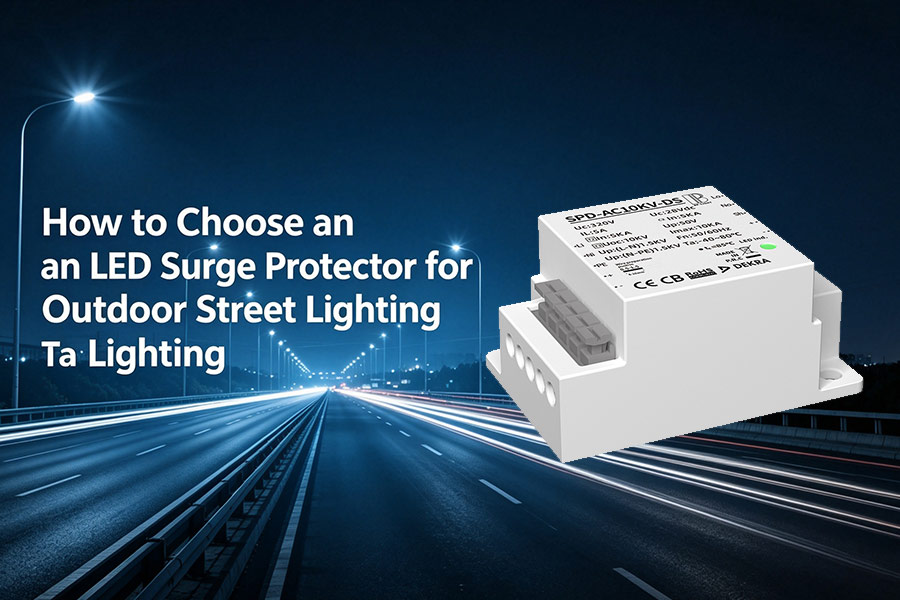
Why LED Street Lights Fail Prematurely — And How Proper SPD Selection Prevents It
Field reports from outdoor road lighting, tunnel lighting, and transportation hub projects consistently cite two failure modes: catastrophic LED driver burnout after nearby lightning strikes, and gradual communication interface degradation in DALI 2.0 or RS485-controlled luminaires. These are not isolated incidents — they reflect systemic exposure. A single surge event on the AC supply (e.g., pole-mounted transformer switching, grid fault recovery) or induced transient on a 1–10V dimming line can exceed the withstand capability of unprotected LED drivers. When this occurs, repair requires full driver replacement, pole access, labor rework, and extended downtime — all increasing total cost of ownership (TCO). Water ingress and thermal cycling further accelerate component stress, but surge transients remain the leading cause of unexplained early-life failures in Class II outdoor luminaires.
The Physics Behind Outdoor LED Surge Vulnerability
Unlike indoor commercial lighting, outdoor street lighting systems operate in electrically hostile environments. Long cable runs between poles act as antennas, picking up electromagnetic energy from direct or nearby lightning strikes. In tunnel or industrial outdoor lighting, switching surges from heavy machinery or HVAC systems compound the risk. Meanwhile, modern control protocols — DALI 2.0, D4i, DMX, RS485 — rely on low-voltage differential signaling (<28Vdc), making them especially sensitive to common-mode transients. Without coordinated protection across both AC power and data lines, one unprotected path becomes the weakest link: a surge entering via the 1–10V wire can destroy the driver’s microcontroller, even if the AC input is protected.
Why Type 2+3 Combined AC & Data Line Protection Is Required
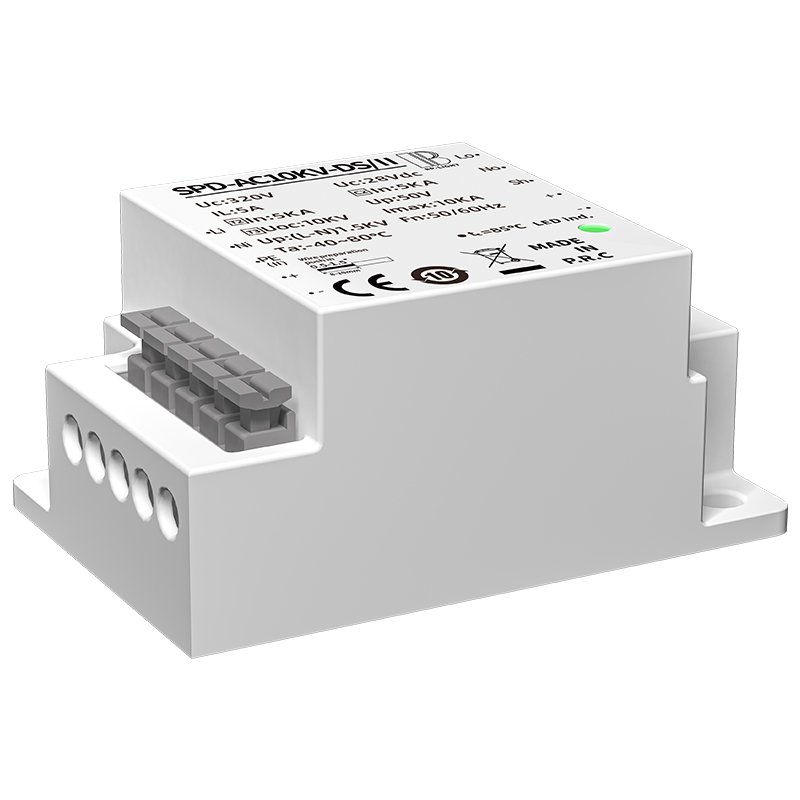
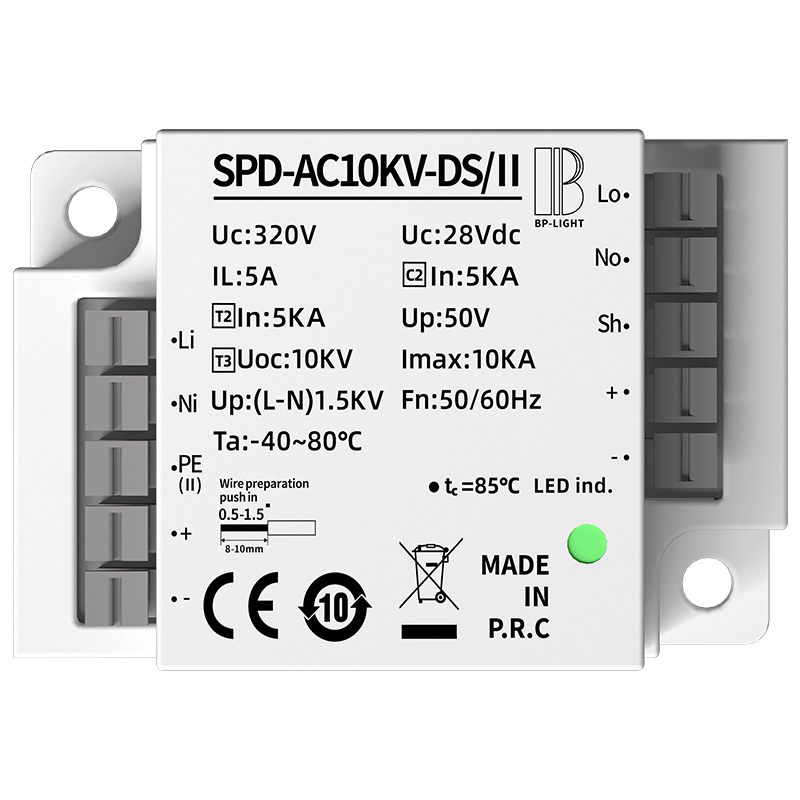
Type 2 SPDs (installed at sub-distribution boards) and Type 3 SPDs (installed close to equipment) serve complementary roles. For outdoor LED lighting, where space inside pole junction boxes is constrained and maintenance access is costly, combining both functions into a single device eliminates coordination gaps and wiring complexity. The SPD-AC10KV-DS/II Series Connected LED SPD is engineered specifically for this requirement: it provides simultaneous protection for 230V single-phase AC supply (Uc = 320Vac) and low-voltage control signals (Uc = 28Vdc), covering DALI 2.0, D4i, 1–10V, DMX, and RS485 interfaces. Its MOV + GDT hybrid technology ensures fast response for high-energy surges while maintaining stable clamping for repetitive transients.
Five Critical Selection Criteria — Verified Against Real Specs
Selecting the right LED SPD is not about maximizing kA ratings — it’s about matching device parameters to system requirements and failure consequences. Based on field validation across outdoor road lighting, landscape lighting, and industrial outdoor lighting applications, these five criteria must be verified:
- Connection topology: The SPD-AC10KV-DS/II uses series connection — meaning it is wired directly in-line with both AC and signal conductors. This design ensures that at end-of-life (e.g., MOV thermal runaway), the circuit opens, preventing uncontrolled operation without protection — a critical safety feature for remote or hard-to-access installations.
- Surge withstand level: With a 10kV combination wave withstand (Uoc) and 10kA maximum discharge current (Imax), the device meets IEC 61643-11 and IEC 61643-21 requirements for coordinated Type 2+3 protection. As clarified in BP-LIGHT’s FAQ, this level is positioned for standard urban street-lighting environments; higher-risk zones (e.g., mountainous road lighting, coastal tunnels) may require reassessment per local lightning exposure data.
- Operating voltage compatibility: Rated for 220–240V nominal input (Un) and 320Vac maximum continuous operating voltage (Uc), it aligns with European and many global 230V single-phase networks. Its 28Vdc Uc for data lines matches the operating envelope of DALI 2.0, D4i, and 1–10V interfaces without over-clamping or false triggering.
- Protection mode coverage: Supports both common-mode and differential-mode protection — essential for suppressing surges between line–earth, neutral–earth, and line–neutral (AC), as well as between signal pair conductors and ground (data).
- Luminaire compatibility: Designed explicitly for Class II luminaires, eliminating the need for PE bonding in double-insulated fixtures — a key requirement for pole-mounted street lights where earth continuity cannot be guaranteed.
Standards Are Not Optional — They Define Interoperability
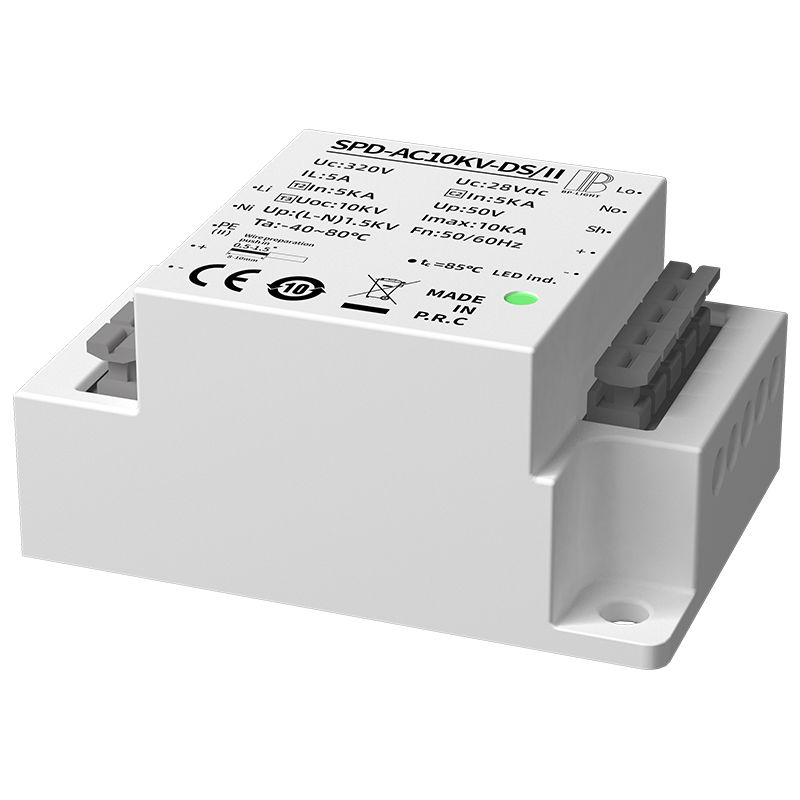
Compliance is not a marketing checkbox — it determines whether your SPD will coordinate reliably with upstream protection and survive third-party testing. The SPD-AC10KV-DS/II carries CE, CB, and RoHS markings and conforms to IEC/EN 61643-11 (for low-voltage power SPDs) and IEC/EN 61643-21 (for signaling and telecom networks). These standards define test waveforms (e.g., 1.2/50 μs voltage, 8/20 μs current), duty cycles, and failure modes — ensuring consistent performance across manufacturers and project sites. Using non-standard or uncertified SPDs risks non-compliance during EPC handover audits or insurance claim reviews.
Installation Notes — Where Wiring Errors Cause Failure
Even a certified SPD fails if misapplied. Common field errors include:
- Using parallel-connected SPDs in pole-top enclosures without fail-safe monitoring — resulting in silent degradation and no indication of protection loss;
- Routing unprotected control cables alongside AC feeders for >30 cm without separation — inducing coupling that overwhelms downstream protection;
- Ignoring temperature derating: while the SPD-AC10KV-DS/II operates from –40°C to +85°C, sustained ambient above 60°C in enclosed pole junction boxes requires verification of thermal management;
- Assuming IP20 rating permits outdoor enclosure use — it does not. IP20 indicates protection against solid objects only; the SPD must be installed within an IP66-rated pole junction box or luminaire housing to meet outdoor environmental requirements.
When to Specify the SPD-AC10KV-DS/II
This device is purpose-built for applications where coordinated AC + data protection, series-interrupt capability, and Class II compatibility are non-negotiable. It is routinely selected by lighting OEMs for:
- Smart street lighting deployments using DALI 2.0 or D4i for adaptive dimming and energy reporting;
- Tunnel lighting systems with RS485-based central monitoring, exposed to switching surges from ventilation fans and emergency lighting inverters;
- Transportation hub lighting (e.g., bus depots, rail yards) where long underground cable runs increase induced surge risk on 1–10V control lines.
Frequently Asked Questions (FAQ)
Q: How do I choose the right surge protection level for LED street lights?
A: Consider the lightning exposure, grid stability, installation environment, luminaire value, and required surge withstand level. BP-LIGHT positions 10kV/10kA protection for standard urban street-lighting environments, while higher-risk environments may require higher protection levels.
Q: What is the difference between series and parallel LED SPD installation?
A: A parallel SPD can allow the luminaire to remain powered after SPD failure, while a series-connected SPD can disconnect power at end-of-life so the luminaire is not left operating without surge protection.
Q: Do DALI and D4i street lights need data line surge protection?
A: Outdoor control lines such as DALI, D4i, 0–10V, 1–10V, DMX and RS485 can be exposed to induced surges. Dedicated signal-line protection helps protect sensitive LED driver communication interfaces.
Q: What SPD standards should I consider for LED lighting?
A: IEC/EN 61643-11 applies to low-voltage power surge protective devices, while IEC/EN 61643-21 covers surge protection for telecommunications and signaling networks.
Q: Is a 10kV LED SPD suitable for outdoor street lighting?
A: A 10kV SPD can be suitable for standard urban street-lighting projects, but the appropriate protection level should be selected according to local lightning exposure, grid conditions and project requirements.
Conclusion
Selecting an LED surge protector for outdoor street lighting demands engineering rigor — not just kA numbers, but verified coordination between AC and data lines, correct connection topology, and standards-aligned certification. The SPD-AC10KV-DS/II delivers Type 2+3 combined protection in a series-connected, Class II-compatible package validated for real-world deployment across road, tunnel, landscape, and transportation lighting. For lighting OEMs, EPC contractors, and distributors requiring technical validation, custom labeling, or ODM integration support, BP-LIGHT Engineering Team offers free selection assistance and application-specific documentation. Request a quote or engineering support.