
UL 1449 vs IEC 61643-11: Which Surge Protection Standard Should You Choose for LED Lighting?
Outdoor LED lighting projects—whether street lighting, roadway illumination, tunnel installations, or commercial exterior systems—face recurring field failures: LED driver burnout after thunderstorms, unexplained luminance drop in industrial zones, repeated SPD replacement due to thermal runaway, or costly rework caused by pole-mounted junction box surges. These are not isolated incidents—they reflect mismatched surge protection selection, particularly when standards compliance is assumed rather than verified.
Why Surge Failure Is Systemic in Outdoor LED Installations
LED luminaires operate at low DC voltages but rely on AC-input drivers sensitive to transient overvoltages. In outdoor environments—especially along roadways, transport corridors, and open industrial sites—lightning-induced surges (direct or induced) and grid-switching transients combine with long cable runs, poor grounding practices, and unshielded pole wiring. Class I luminaires, commonly deployed across these applications, require coordinated SPD protection upstream of the driver input. Without appropriate coordination and standard-aligned testing, even high Imax-rated devices may fail to limit voltage stress (Up) below the driver’s withstand level—or worse, mask thermal failure risks due to lack of integrated disconnect.
How LED SPDs Address Real-World Failure Modes
A dedicated LED Surge Protection Device (LED SPD) is engineered for the unique electrical profile of LED drivers—not generic power distribution. Unlike Type 2 SPDs designed for main panels, LED SPDs like the BP-SPD10KV-4P/VIP/2 are optimized for parallel connection directly at the luminaire input, enabling localized clamping before transients reach the driver. Its parallel topology ensures no interruption to power during operation and supports thermal disconnect functionality—critical for preventing fire risk during sustained overvoltage events.
Key Selection Criteria—Based on Verified Specs
Selecting an LED SPD requires attention to application-specific parameters—not marketing claims. For outdoor LED lighting systems operating at 220–240V nominal supply:
- Maximum Continuous Operating Voltage (Uc): Must match system voltage range—220–240V for this model—ensuring reliable clamping without premature aging.
- Nominal Discharge Current (In) & Maximum Discharge Current (Imax): In = 5kA, Imax = 10kA indicate tested capability under standardized 8/20 µs current waveforms—relevant for recurrent surges in high-exposure locations like transportation hubs or coastal roadway lighting.
- Connection Method: Parallel connection simplifies retrofitting into existing pole bases or junction boxes without rewiring; push-in + screw fixation accommodates conductor cross-sections from 1.0–2.5mm², supporting common stranded or solid-core installation cables.
- Environmental Suitability: Operating temperature range of −40°C to +85°C covers extreme outdoor deployment—from arctic municipal lighting to desert industrial yards—while PC housing (RAL9003) provides UV resistance and mechanical robustness.
- Applicability: Certified for Class I luminaires, aligning with safety requirements for grounded metal-body fixtures widely used in street, tunnel, and landscape lighting.
Standards Are Not Interchangeable—They Define Market Access
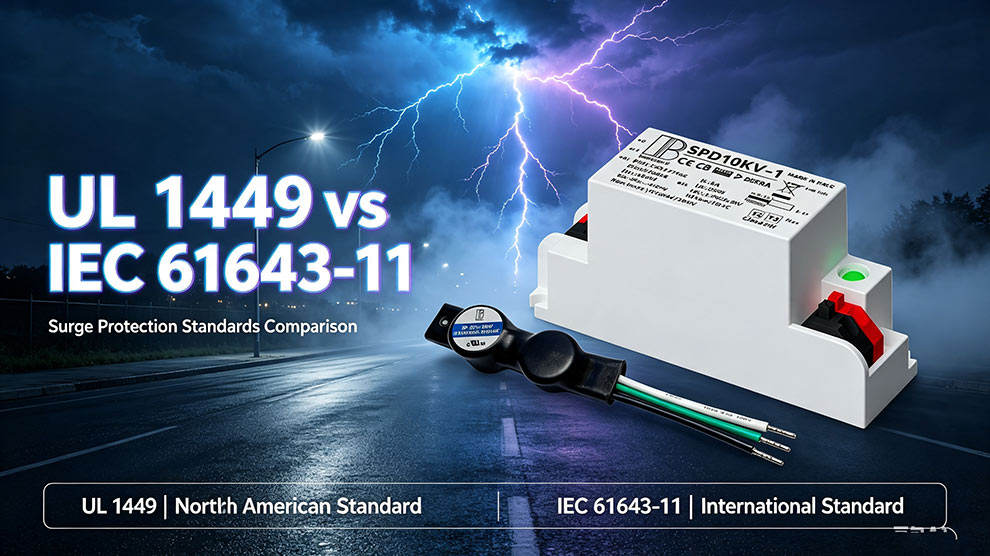
UL 1449 (North America) and IEC 61643-11 (global, including EU, APAC, Middle East) define distinct test protocols, performance thresholds, and safety validation paths. UL 1449 emphasizes end-use reliability—including follow-current interruption and thermal endurance under fault conditions—while IEC 61643-11 focuses on impulse response, voltage protection level (Up), and coordination with upstream protection. Neither supersedes the other; they serve different regulatory ecosystems.
The BP-SPD10KV-4P/VIP/2 carries CE, CB, and RoHS certifications—validating conformity with IEC 61643-11–aligned testing and EU market access. It does not carry UL 1449 listing. Buyers specifying this device must confirm whether their project mandates UL-listed SPDs (e.g., U.S. DOT or Caltrans contracts) or accepts CB Scheme–recognized IEC-compliant products (common across EMEA, ASEAN, GCC infrastructure tenders).
Installation Notes and Common Pitfalls
Even a correctly specified LED SPD fails if improperly installed:
- Avoid daisy-chaining SPDs: The BP-SPD10KV-4P/VIP/2 is designed for parallel connection at the luminaire—do not series-connect multiple units.
- Respect conductor limits: Use only 1.0–2.5mm² conductors; undersized wires increase impedance and reduce effective clamping performance.
- Grounding integrity matters more than SPD rating: An IP20-rated device (intended for indoor pole base or sealed junction box use) relies entirely on low-impedance earthing—verify ground resistance ≤10 Ω before commissioning.
- Do not omit thermal disconnect verification: This model includes thermal disconnection—confirm visual status indicators (if present per batch) or plan periodic inspection where ambient temperatures exceed 70°C.
Application-Specific Fit: Where BP-SPD10KV-4P/VIP/2 Delivers Value
This LED Surge Protection Device (LED SPD) is purpose-built for scenarios where coordinated, localized protection is non-negotiable:
- Outdoor LED street lighting: Installed inside pole bases, it protects drivers from induced surges across multi-luminaire circuits without requiring cabinet-level SPD upgrades.
- Tunnel lighting: Withstands wide temperature swings and provides stable Uc margin across 220–240V fluctuating supplies typical in long-tunnel feeders.
- Transportation hubs (airports, rail stations): Its 10kA Imax rating addresses high lightning exposure zones while CB certification supports international procurement workflows.
Frequently Asked Questions (FAQ)
Q: What is the difference between UL 1449 and IEC 61643-11?
A: The applicable standard depends on the target market and project requirements. Buyers should always confirm which certification or standard is required before selecting an LED surge protection device.
Q: Can one LED SPD satisfy every project requirement?
A: No. Surge protection requirements vary depending on installation environment, electrical system, and customer specifications.
Q: How should I choose between different surge protection levels?
A: The appropriate protection level should be selected according to the project’s electrical design, environmental conditions, and specification requirements.
Q: Is IP20 sufficient for outdoor pole-mounted applications?
A: Yes—when installed within a sealed, IP65+ rated pole base or junction box. IP20 indicates protection against finger contact and solid objects ≥12.5 mm, not direct weather exposure. Always verify enclosure IP rating and sealing integrity.
Q: Does BP-SPD10KV-4P/VIP/2 support DIN-rail mounting?
A: Mounting method is not specified in provided data. Refer to the product page or request the Installation Manual for mechanical fit details.
Q: Are replacement modules available separately?
A: Module serviceability is not specified in provided data. Contact BP-LIGHT Engineering Team for OEM/ODM support or lifecycle documentation.
Conclusion
Selecting an LED SPD is not about maximizing kA ratings—it’s about matching certified performance to real-world electrical architecture, environmental stress, and regulatory gateways. The BP-SPD10KV-4P/VIP/2 delivers verified 10kA Imax, Class I compatibility, and IEC-aligned certification for outdoor LED lighting applications spanning street, tunnel, transport, and industrial sites. Its parallel connection, thermal disconnect, and broad temperature tolerance address core field failure modes—without overpromising.
For lighting OEMs, EPCs, and contractors: always validate standard requirements upfront, confirm enclosure IP coordination, and size conductors to spec. Need help selecting the right LED Surge Protection Device (LED SPD) for your next tender or production run? Request engineering support or an OEM/ODM quote.